Wildlife

Successful Completion of Snake Management Training!

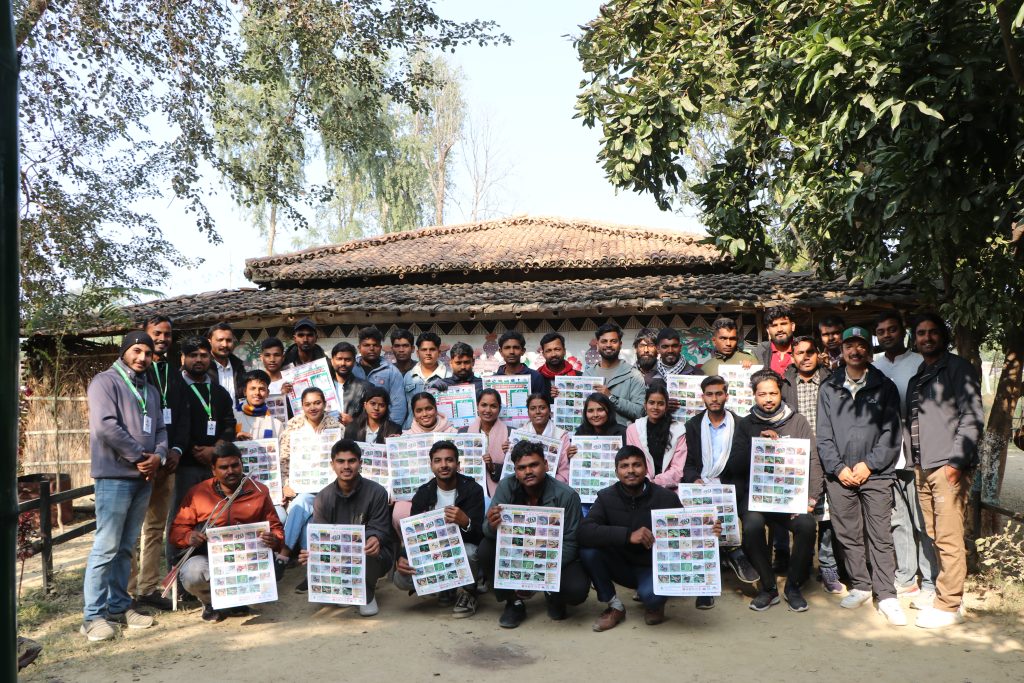
We are glad to announce the successful completion of our 3-day “Snake Management Training”, a vital step toward reducing snake, human conflicts and promoting peaceful coexistence with wildlife. We extend our sincere gratitude to our expert trainers Rohit Giri, Subodh Acharya, and Dev Narayan Mandal (Founder & CEO of Mithila Wildlife Trust)for their dedication and invaluable knowledge. Special thanks to PIPAL TREE for their incredible support and to everyone who played a role in making this training a success. This initiative brought together a diverse group of participants, including citizen scientists, veterinary and health workers, farmers, and community members ,who have embraced a new perspective on living harmoniously with snakes. Through this training, they have gained essential skills to handle snake-related situations responsibly while understanding the crucial role snakes play in our ecosystem. Together, we are fostering a more informed, safer, and wildlife-friendly community.

Successful Completion of Snake Management Training! Read More »

Snake Management Training Get ready! Only 4 days to go

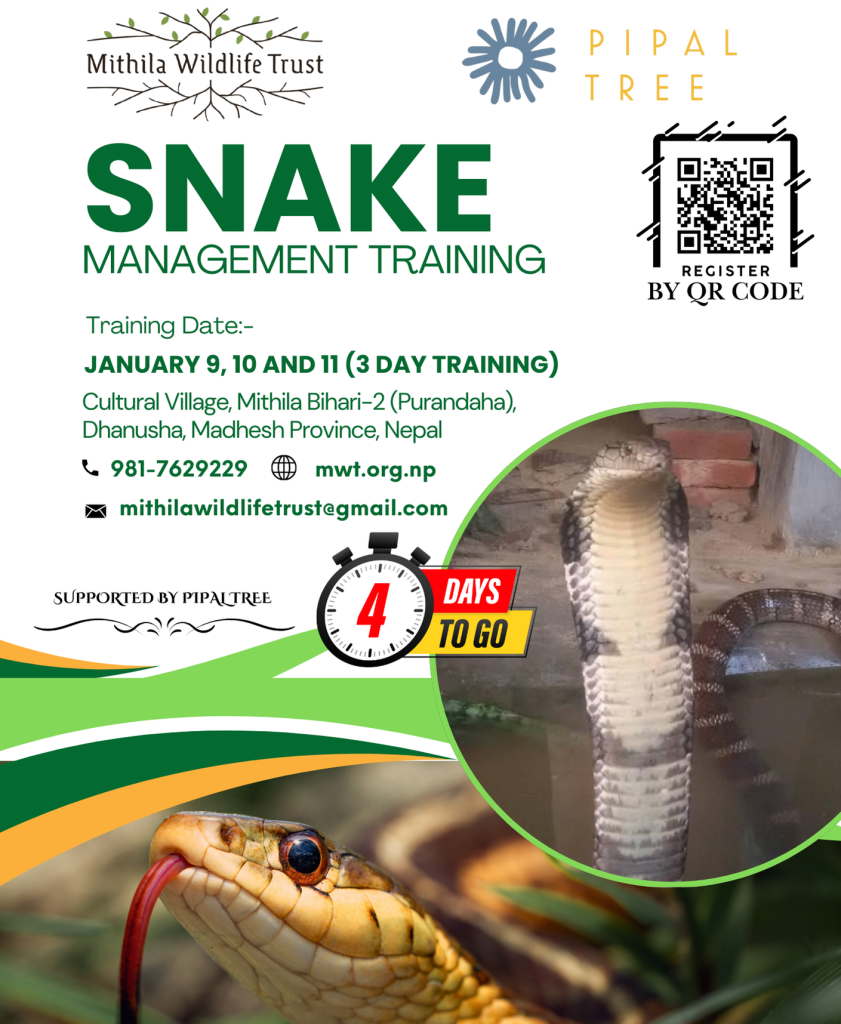
Join us for a comprehensive 3-days Snake Management Training organized by Mithila Wildlife Trust t in coordination with Save The Lives and supported by Pipal Tree , UK from January 9-11, 2025. The training is planned to produce Snake rescuers who rescue the snakes in their own locality. This is an initiative to promote human-snake co-existence and mitigate human lives loss due to snake bite. The residential training will be organized at Cultural Village, Mithila Bihari-2 (Purandaha), Dhanusha, Madhesh Province, Nepal. The trainee will be guided by some of leading community based snake rescuers of Nepal. We highly encourage to citizen scientists of Dhanusha district.

Snake Management Training Get ready! Only 4 days to go Read More »

Consultation Meeting with Policymakers of Province No.-2, Nepal

It’s really a proud moment to get the opportunity to welcome major policymakers of Province No.-2 to Mithila Wildlife Trust office in Janakpurdham. An in-depth discussion was done on the overview, opportunities, and threats to the wildlife of Province No.-2 with Dr. Ram Chandra Kandel, Honorable Secretary, Most senior Forestry expert and Environment Division Chief, Mr. Nand Lal Ray Yadav, and Coordinator to wildlife conservation initiatives in Province and AFO Sujit Kumar Jha and Planning Division Chief from Ministry of Industry, Tourism, Forest and Environment, and Mr. Jagarnath Jaysawal, Directory, Provincial Forestry Directorate, Province No.-2. The entire Mithila Wildlife Trust family is grateful to all the respective personalities and leaders to forest and wildlife conservation activities in Nepal for the opportunity to welcome you all to our office. And, for always being there to motivate the conservation enthusiasts. The whole discussion was concentrated on the hotspots and strategic locations within Province No.-2. Mr. Dev Narayan Mandal, Chairman, Mithila Wildlife Trust presented the present scenario and future perspective of wildlife conservation in the province. Honorable secretary committed to lobbying at ministry level on the discussed strategies where Forestry Director shared the opportunities of basketing for implementation of the activities. Mr. Aaditya Pal, Wildlife Research Officer, and Mr. Ganesh Sah, Research Assistant and Research Assistant shared their experience on the opportunities related to birds and reptiles. Mr. Chandan Thakur, Aadarsh Mishra, and other team members managed the technical management during the meeting. Some of the major points included in the discussion were present threat to the wildlife in the province, the status of the wildlife corridor between Parsa National Park (PNP) to Koshi Tapu Wildlife Reserve (KTWR) in the province, human-wildlife conflict, and poaching of wildlife in the province, opportunity and challenges to corridor restoration, a site visit to biological hotspot within the province, landscape-level corridor restoration in the province, encouragement and motivation to the active Community Forest User Groups, possibilities of underpass construction at some vulnerable wildlife crossings and alternatives to the corridor to protect existing forest and wildlife within the province. The discussion will definitely guide us to prepare a strategic guideline for all forest and wildlife lovers. We are grateful once again for the encouraging words of all respected personalities.


Consultation Meeting with Policymakers of Province No.-2, Nepal Read More »

First record of leucism in Kraits Bungarus walli and B. niger by Mithila Wildlife Trust

It is our immense pleasure to share the news that long awaited article on “First report of leucism for the kraits Bungarus walli Wall, 1907 and B. niger Wall, 1908, with updates on their geographic distribution in Nepal (Serpentes, Elapidae)” has been published by Herpetology Notes. Being the First record of leucism for the Kraits Bungarus walli and B. niger, it is equally important to entire team. Read full article at https://www.researchgate.net/publication/344570034. Both snakes were rescued by Mr. Ganesh Sah (also co author to this article). You will be amazed to know that Ganesh Sah connected to Mithila Wildlife Trust (MWT) when he was in Class-8 in the village school. Awareness raising painting competition in the schools surrounding Dhanushadham Protected Forest connected him with us in 2015. Since then, Ganesh is active in rescue, relocation and rehabilitation of wildlife in Dhanusha district. He has rescued hundreds of reptiles personally and is assisting in day to day activities of MWT. He has keen interest in wildlife photography, birding and research in the field. Being a citizen scientist, he knows a lot about wildlife and is a leading nature guide in the area. MWT team is fond of him being passionate and dedicated towards nature and wildlife conservation since his childhood. The snake was released into natural habitat by Ganesh Sah after capturing images for record. A huge thanks to Kamal Devkota ji, Mark O Shea and Hinrich Kaisar for shaping the information into article and we all are grateful to Herpetology Notes for publishing our effort. As always, support of Divisional Forest Office, Dhanusha and staff of Dhanushadham Sub-Division Forest Office, Dhanushadham Protected Forest is always motivating factor for our conservation activities. Thank you all helping hands!

First record of leucism in Kraits Bungarus walli and B. niger by Mithila Wildlife Trust Read More »

Large Indian Civet, recorded by Mithila Wildlife Trust (MWT) in Dhanusha, Province-2, Nepal

The nature never fails to amaze us by its infinite beauty. Another IUCN Red Listed animal since 2008, the Large Indian civet is also captured by Mithila Wildlife Trust at the Bhatighadi Community Forest by a camera trap.   Video footage of Camera Trap by Mithila Wildlife Trust The Large Indian civet is scientifically known as (Viverra zibethanative). It is native to South and Southeast Asia. The large Indian civet inhabits scrub, grasslands, and densely forested areas in (India, Nepal, Bhutan, southern China, and Bangladesh). There are black spots on its body and stripes of black and white on the sides of which have a large body with gray or brown color. Its tail has several black rings around it. Breeding takes place at any time of the year. Litters are born in very dense vegetation or in a hole in the ground. Young are able to open their eyes within ten days. Mothers raise their young on their own. The males are slightly bigger than the females. This species uses a wide variety of wooded habitats, both evergreen and deciduous, as well as grasslands, scrub-land, and plantations. It is often found near human habitation. large Indian civets are carnivorous, preying on birds, frogs, snakes, chickens, hens, and small mammals. They also eat fruit, eggs, roots, fish, and crabs. It lives in a hole in the ground that another animal has dug.  They travel extensively, average daily and monthly distances estimated as being from 1.7 km to 5.4 s. The Large Indian civet is also captured by Mithila Wildlife Trust at the Bhatighadi Community Forest by a camera trap.    

Large Indian Civet, recorded by Mithila Wildlife Trust (MWT) in Dhanusha, Province-2, Nepal Read More »