

Animals

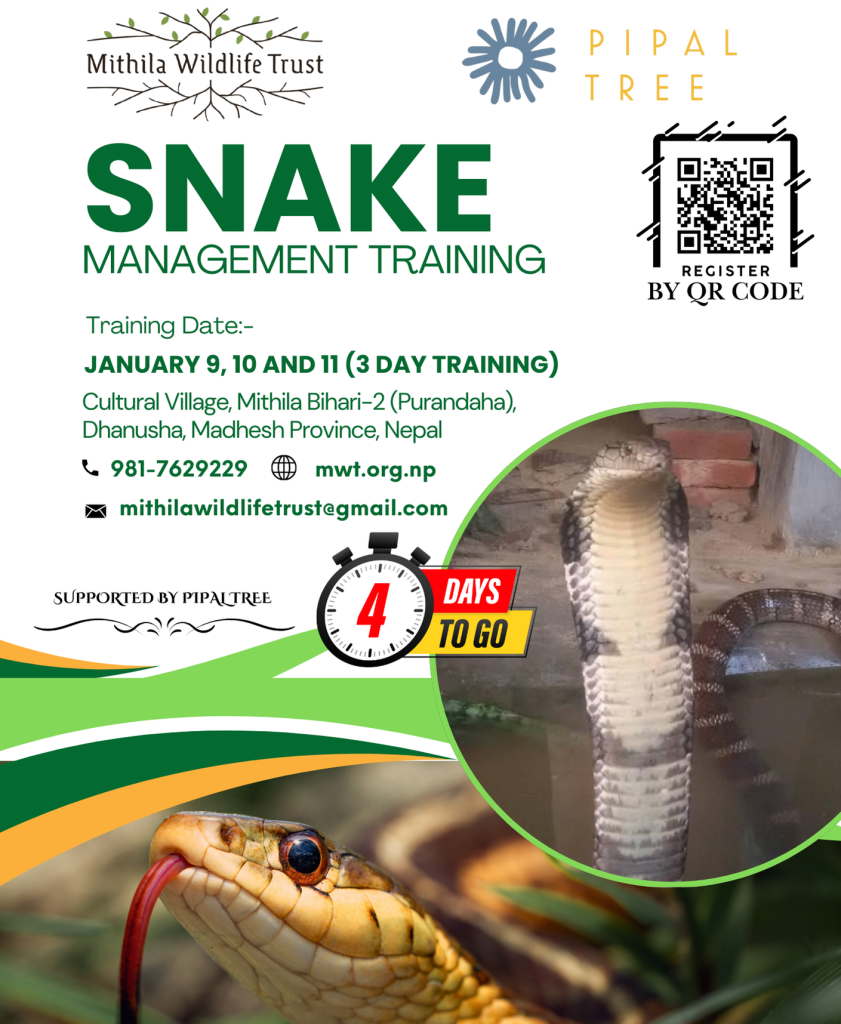
Snake Management Training Get ready! Only 4 days to go

Join us for a comprehensive 3-days Snake Management Training organized by Mithila Wildlife Trust t in coordination with Save The Lives and supported by Pipal Tree , UK from January 9-11, 2025. The training is planned to produce Snake rescuers who rescue the snakes in their own locality. This is an initiative to promote human-snake co-existence and mitigate human lives loss due to snake bite. The residential training will be organized at Cultural Village, Mithila Bihari-2 (Purandaha), Dhanusha, Madhesh Province, Nepal. The trainee will be guided by some of leading community based snake rescuers of Nepal. We highly encourage to citizen scientists of Dhanusha district.

Snake Management Training Get ready! Only 4 days to go Read More »

Pangolin Conservation in Province No.-2, Nepal

Eight species of Pangolins are found in the world, among them, two species are found in Nepal; Chinese pangolin (Mani spentadatyla) and Indian pangolin (Manis crassicaudata) are found in Nepal. In Nepali, Chinese pangolins called Kalo salak and Indian pangolin is called Tame salak. In Terai, Pangolins are locally known as Sal Machhari. Pangolins hold the title of most trafficked animal in the world. Its scale is largely used in China and Vietnam for various purposes from meat, medical to luxury, and many more. Pangolins are very elusive mammals and like to live inside the burrows and are more active at night. They are solitary animals and hard to see in the wild. They are a very slow breeder and gives birth to a single baby in a year. When we talk about the conservation of wildlife people have more interest and inquiry a lot about its importance in day-to-day life. As we know, Nepal is an agricultural county and the majority of people still depend on farming. Pangolins are a boon for them, Pangolins not only nourished the soil but eat the insects that feed on our crops. One adult Pangolin consumes more than 70 million ants and termites in a year. Which is immensely useful for crops and vegetation. Data from the paper of Tulshi Laxmi Suwal (2020) describes that among eight districts of Province No:-2, Saptari has been confirmed to have Chinese pangolin and Parsa has confirmed to have Indian pangolin, and reaming all five districts have evidence of the presence of pangolin. Habitat destruction is a major problem in forests of lowlands these days. Lack of awareness about wildlife conservation is another challenging work. Our work should be a focus on documenting the evidence of Pangolin with the motto to think globally and act locally, we celebrate World Pangolin day to create awareness about this elusive creature. Join us to conserve Pangolin and other wildlife in Province No.-2 of Nepal.

Pangolin Conservation in Province No.-2, Nepal Read More »

Wild Cat Conservation (WCC) Programs are being conducted in Bara, Province-2, Nepal

Mithila Wildlife Trust has been working for Wild Cat Conservation in Janajagriti Sundar, Janashrijansil, and Baghbhairav Community Forests in Nijgadh municipality, Bara with a focus on Tiger and Leopard. The program is supported by the Zoological Society of London and Wild Cat Conservation Alliance where the ZSL Parsa Field Office, Division Forest Office – Bara, Parsa National Park, and local communities have joined together to succeed the program. MWT has been focusing on community-based conservation and human-wildlife co-existence in Churia foothills since the establishment. We strongly believe that this is a community that spends 24 hours with the wildlife, thus, encouraging them and boosting their capacity to provide a natural habitat for them will be sustainable conservation. We strongly believe that “the more community knows about wildlife in their surrounding, the less conflict will be there”. Thus we have been working closely with the community residing in the Churia foothills. As the number of Wild cats is increasing in Parsa National Park (PNP), they are moving to the dense community forests in their surroundings to search for new and secure habitats for them. This is where our role starts. We work with the communities to aware of the natural behavior, hunting, and feeding behavior and their role and importance to maintain the natural ecosystem. This ensures that the community is well prepared and aware of the new members in their community forests. The existence of Tiger and Leopard in the community forests are making the community happier as they are mostly affected by Wild Boar and Blue Bull which is natural prey to them. Community interactions and awareness-raising activities in schools become more necessary as they are the one who enters inside the forest for several activities, be it, collecting fallen small branches of the tree for firewood or for forages to their animals. This becomes necessary to mention here that Baghbhairav Community Forest has restored 100-hectare river bank and Janajagriti Sundar Community Forest has restored 40-hectare river bank as a dense forest which is becoming one of the major habitats to several wildlife species in their forests including Tiger and Leopard. We are grateful to community school management, community members, and stakeholders for always being there to support us. We don’t know how to thank Mr. Prachanda Maharjan and Sandeep Chaudhary from the Zoological Society of London, Parsa Field Office during the implementation of Wild Cat Conservation Programs.

Wild Cat Conservation (WCC) Programs are being conducted in Bara, Province-2, Nepal Read More »

First record of leucism in Kraits Bungarus walli and B. niger by Mithila Wildlife Trust

It is our immense pleasure to share the news that long awaited article on “First report of leucism for the kraits Bungarus walli Wall, 1907 and B. niger Wall, 1908, with updates on their geographic distribution in Nepal (Serpentes, Elapidae)” has been published by Herpetology Notes. Being the First record of leucism for the Kraits Bungarus walli and B. niger, it is equally important to entire team. Read full article at https://www.researchgate.net/publication/344570034. Both snakes were rescued by Mr. Ganesh Sah (also co author to this article). You will be amazed to know that Ganesh Sah connected to Mithila Wildlife Trust (MWT) when he was in Class-8 in the village school. Awareness raising painting competition in the schools surrounding Dhanushadham Protected Forest connected him with us in 2015. Since then, Ganesh is active in rescue, relocation and rehabilitation of wildlife in Dhanusha district. He has rescued hundreds of reptiles personally and is assisting in day to day activities of MWT. He has keen interest in wildlife photography, birding and research in the field. Being a citizen scientist, he knows a lot about wildlife and is a leading nature guide in the area. MWT team is fond of him being passionate and dedicated towards nature and wildlife conservation since his childhood. The snake was released into natural habitat by Ganesh Sah after capturing images for record. A huge thanks to Kamal Devkota ji, Mark O Shea and Hinrich Kaisar for shaping the information into article and we all are grateful to Herpetology Notes for publishing our effort. As always, support of Divisional Forest Office, Dhanusha and staff of Dhanushadham Sub-Division Forest Office, Dhanushadham Protected Forest is always motivating factor for our conservation activities. Thank you all helping hands!

First record of leucism in Kraits Bungarus walli and B. niger by Mithila Wildlife Trust Read More »

Large Indian Civet, recorded by Mithila Wildlife Trust (MWT) in Dhanusha, Province-2, Nepal

The nature never fails to amaze us by its infinite beauty. Another IUCN Red Listed animal since 2008, the Large Indian civet is also captured by Mithila Wildlife Trust at the Bhatighadi Community Forest by a camera trap.   Video footage of Camera Trap by Mithila Wildlife Trust The Large Indian civet is scientifically known as (Viverra zibethanative). It is native to South and Southeast Asia. The large Indian civet inhabits scrub, grasslands, and densely forested areas in (India, Nepal, Bhutan, southern China, and Bangladesh). There are black spots on its body and stripes of black and white on the sides of which have a large body with gray or brown color. Its tail has several black rings around it. Breeding takes place at any time of the year. Litters are born in very dense vegetation or in a hole in the ground. Young are able to open their eyes within ten days. Mothers raise their young on their own. The males are slightly bigger than the females. This species uses a wide variety of wooded habitats, both evergreen and deciduous, as well as grasslands, scrub-land, and plantations. It is often found near human habitation. large Indian civets are carnivorous, preying on birds, frogs, snakes, chickens, hens, and small mammals. They also eat fruit, eggs, roots, fish, and crabs. It lives in a hole in the ground that another animal has dug.  They travel extensively, average daily and monthly distances estimated as being from 1.7 km to 5.4 s. The Large Indian civet is also captured by Mithila Wildlife Trust at the Bhatighadi Community Forest by a camera trap.    

Large Indian Civet, recorded by Mithila Wildlife Trust (MWT) in Dhanusha, Province-2, Nepal Read More »